


Guest blog by Destinie Reynolds, Historian and Researcher
2026 marks 45 years since the 1981 uprisings, when thousands of Black people supported by their working-class allies across Britain took to the streets to fight back against decades of state racism, unemployment and discrimination. From Brixton to Toxteth, Handsworth to Moss Side, 1981 has been remembered through dramatic images of burning buildings, disorder and intense clashes between the police and the people. The British state, at the time led by Margaret Thatcher’s Conservative government, alongside the mainstream media, constructed and disseminated a narrative of gratuitous ‘riotous disorder’. This characterisation obscures the agency and resistance of the communities that were challenging systemic racism (Hirsch, 2020).
However, the communities themselves captured a different story – one of uprising, resistance and grassroots organising. Preserved in flyers, newsletters, reports and oral histories is a record of collective struggle. These documents provide a crucial counternarrative to the sensationalism of the mainstream media, revealing these uprisings as a militant and radical response to the racism embedded within every layer of British society. By recentring these voices and engaging with grassroots community histories, scholars can challenge dominant accounts of the 1981 uprisings.
The 1981 uprisings were fundamentally local in character. Rooted in the inner-city communities that were home to many of Britain’s post-war Windrush migrants, the nature of the 1981 uprisings was shaped by the lives, organisations and networks of resistance these communities had constructed across the mid-Twentieth Century. Moss Side was one such community. The Elouise Edwards Collection (GB3228.5) at the Ahmed Iqbal Ullah RACE Centre and Educational Trust holds vital archival materials that facilitate a powerful corrective to the dominant accounts. The collection has a dual function, recording both experiences of police brutality and how these experiences were understood, felt, named and challenged by the community. Additionally, the collection has carried forward the legacy of community-led campaigns, initiatives and organisations that emerged in Moss Side as residents organised to survive, confront racist exclusion and build mutual support networks. Taken together, these materials propel these hidden histories into view to recite a history of struggle, political mobilisation and resistance.
By problematising dominant narratives through engaging with community archives, this article challenges the image of the 1981 uprising as a moment of impulsive disorder. Instead, it foregrounds grassroots voices to enable a fuller reconstruction of Moss Side’s 1981 uprising. In doing so, it reveals a history of resistance, political agency and community organising that has too often been obscured within public memory.
In Moss Side, the uprising began in the early hours of 7 July 1981 following a racist confrontation involving Black residents leaving a local club. Longstanding tensions over racism, police harassment and the over-policing of Moss Side’s Black community, and social inequality spilled onto the streets, leading to three days of sustained resistance. Former Chief Constable James Anderton dismissed the uprisings as ‘near lunacy and anarchy’; however, reading against the grain of contemporary media reporting reveals a different history.
While the state relied on vehicle-based rapid dispersal tactics, only ever before used by the British Army in the North of Ireland, in an attempt to regain control; the Black community mobilised with a clear purpose and political intent. Indeed, the uprising itself constituted an articulation and performance of a critique of Thatcherism, the dire material conditions of the inner city, and racialised inequalities. The Manchester Evening News (MEN) reported on protestors targeting Moss Side Police Station, allegedly led by a nine-year-old boy (James, 1982). Although the article sought to frame targeting the station as an aberrant spectacle, when read through an anti-racist lens, the article discloses an emergent political consciousness embedded within the community. The station had long been associated with police harassment and brutality, making it a formidable focal point for collective anger. In confronting Moss Side Police Station and challenging the state head-on, protesters transformed a site of pain, fear and injustice into a symbol of resistance and resilience.
Occasionally, glimpses of this state-sanctioned and extra-legal violence surfaced in the mainstream press. In a rare departure from dominant coverage, a letter from community workers published in The Guardian described police officers as ‘uniformed hooligans beating their truncheons’ and hurling racial abuse at residents. It is important to note that a community voice was present in a national newspaper. However, significantly, what the article also indicates is that evidence of police racism during the uprisings was visible in the public record – despite being overshadowed by dominant narratives of disorder and criminality.
The majority of the press parroted the state’s language of panic and criminality. The MEN implored Prime Minister Margaret Thatcher to act ‘before it’s too late and we are hit by a holocaust’, while national newspapers repeatedly referenced protesters wearing ‘IRA-styled masks’. In doing so, the media racialised the crisis, constructing Black communities as dangerous outsiders and legitimising calls for greater policing and repression. Ultimately, these narratives were central to shaping public memory of 1981, embedding images of anarchy and threat in the public imagination while obscuring the racist police violence.
However, hidden beneath this discourse lies the community materials preserved in local archives, which spotlight the networks of self-determination and solidarity. The Elouise Edwards Collection (GB3228.5) holds a host of handwritten leaflets and flyers from various defence campaigns which chronicle the community’s ability to organise and mobilise self-defence. These materials also function as evidence of a community with the resources, skills and organisational capacity to produce and circulate its own political messages, independent of both the state and the mainstream media. The collection as a whole affirms that the defence of the community after 1981 was not simply a reaction to a moment of crisis, but part of a broader tradition of Black radical organising in post-1948 Manchester.
One particularly revealing source is a leaflet from the Free James Gittings campaign (GB3228.5/3/35) which operated out of the Moss Side People’s Centre. 17-year-old Gittings was sentenced to six years in prison for allegedly throwing a petrol bomb during the uprisings. Immediately, the text rejects the term ‘riots’ and instead draws attention to the indiscriminate mass arrests and police violence against the entire Moss Side community. It continues to expose the weaknesses of the prosecution’s case: the lack of evidence and inconsistent timelines. Crucially, the leaflet concludes by outlining clear, actionable steps to support the campaign, demonstrating how campaigns aimed to raise political consciousness and mobilise the entire community. Moreover, its connection to the Moss Side People’s Centre enables historians to trace how the community networks and spaces that underpinned local activism were coordinated and sustained.
Similarly, a leaflet produced by the Moss Side Community Action Group (GB3228.5/3/13) in the aftermath of the uprisings provides insight into how local residents interpreted the events and contested mainstream narratives. Rather than depicting young people as criminals, the leaflet expresses fears of arbitrary arrests and promotes community support through youth clubs, first aid, and medical assistance. The leaflet also argues that institutional neglect had ‘the effect of demoralising and dividing us as a community,’ before calling for a public meeting to discuss the depths of the crisis and democratically build an anti-racist resistance struggle. The leaflet concludes with the rallying cry that ‘together we can bring this reign of terror to an end.’
After the week of uprisings, the Moss Side Defence Committee (MSDC) emerged as the leadership of the community resistance. This group channelled the communal anger of residents into an organised movement dedicated to the cultural, political, social and economic liberation of Moss Side’s working-class community. The MSDC’s principle aims surrounded the uprisings, financially supporting prosecuted protestors and developing a defence campaign demanding the dismissal of all charges (MSDC, date unknown). The committee acted as an agitational force, unifying the community against a common enemy: the British state. The first MSDC meeting attracted over 100 community members and marked a significant escalation in community organising.
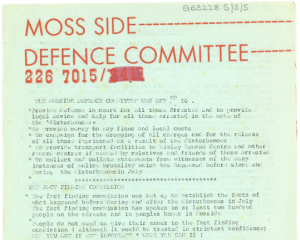
Extract from Moss Side Defence Committee document outlining aims and responsibilities, GB3228.5/2/5
One of the MSDC’s principal campaigns was its boycott of the Hytner Inquiry, established by Greater Manchester Council to investigate the causes of the 1981 uprisings. The MSDC immediately denounced the biased and exclusionary nature of the Inquiry that acquiesced in the dominant discourse surrounding the uprising and was willing to protect the police and further marginalise the Black community. The committee widely distributed the ‘Boycott the Hynter Inquiry’ leaflet (GB3228.5/3/5) at the height of their political significance, reflecting their discontent with the government-led investigation. The leaflet presented community concerns about the inquiry potentially omitting the systemic issue and underlying unrest – presenting their resolve to fight for their interests independently. The leaflet draws attention to the inquiry as a superficial attempt to address police prejudice and encourages the boycott of the inquiry. This material granted the Black community agency and importantly highlights the importance of self-empowerment through an independent anti-racist street movement, outside the confines of British state institutions, that will hold the police accountable on their terms. Once the Inquiry’s findings were released, the MSDC correctly pointed out that it functioned as a ‘thin veneer of liberalism, humanity and scholarship [and a] superficial appearance of a balanced and objective analysis’ (MSDC, 1981).
The struggle over the meaning of 1981 is ultimately a struggle over memory itself. For decades, official accounts have privileged narratives of disorder, obscuring the racism, policing and inequality that gave rise to the uprisings. The community records preserved in the Elouise Edwards Collection (GB3228.5) challenge this erasure by amplifying the voices of those who lived, organised and resisted. Recovering these histories is not simply an academic exercise; it is a political act that reclaims Black agency and ensures that the legacy of 1981 is remembered on the community’s own terms.
Bibliography
Shirin Hirsch, ‘Photojournalism and the Moss Side Riots of 1981: Narrowly Selective Transparency’, History Workshop Journal, 89 (2020), 221-245
C.L.R James, ‘Free For All: The Nine Year Old Leader’, Race Today, 14:3, May-June 1982
Moss Side Defence Committee, ‘Moss Side and the Police’, Elouise Edwards collection, GB3228.5/3/21, Ahmed Iqbal Ullah RACE Centre
Moss Side Defence Committee, ‘The Hytner Myths: A preliminary critique of the Hytner report’ (1981), Elouise Edwards collection GB3228.5/3/19, Ahmed Iqbal Ullah RACE Centre
Take down notice
At the Ahmed Iqbal Ullah RACE Centre we make every effort to identify and contact rights holders of any archive material we use in our online resources. Unfortunately we are not always successful and we recognise that sometimes material published online may be in breach of copyright laws.
We would like to find more information about rights holders of material in our collections. If you have any information about possible rights holders of material on this page, or you are a rights holder and are concerned that you have found material on this page for which you have not given permission, please do get in touch at [email protected].