
Hello, again! It’s Rahel, the summer intern at the RACE Centre. For those who don’t know me, I study history as a mature student at Smith College in Massachusetts, USA. You can learn more about me through my introduction interview on our blog.
Over the last seven weeks, I’ve been digging into our U.S. collections to produce a subject guide for our website and a curated collection in partnership with the University of Manchester Libraries’ Digital Collections. So, what have I done so far? Well…
Work Undertaken, Methods and Findings:
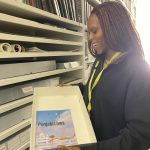
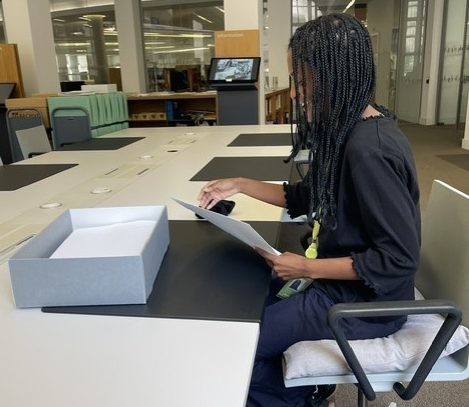
I spent most of my internship processing, which meant I would review collection items for their condition, potential use, and identifying characteristics (metadata). The RACE Centre carries over 800 items on the U.S. (9% of our catalogue!), so there was a lot of ground to cover!
To start, I reviewed our existing archival collections, such as the US Civil Rights Archive, the New York City Teachers’ Strike Collection, and the Lou Kushnick Collection. Historical items can tell us information about specific people, movements, and events, so I tracked these themes as I reviewed. These key themes helped me source books, films, and other archives in our library, Manchester Libraries, and the University of Manchester Libraries that contextualize the materials we have. In making these connections, I learned we hold several rare books that we’re now planning to archive. Some of my favourites include:
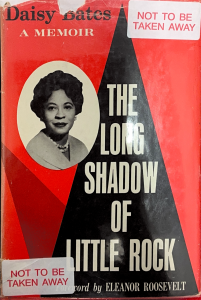
Daisy Bates – The Long Shadow of Little Rock (HI.3.02/BAT). After the U.S. Supreme Court struck down segregation in public education, Bates and eight other African American students in Little Rock, Arkansas were some of the first in the country to attend previously all-white schools. Her eyewitness account on desegregation as part of the Little Rock Nine drew national praise and ire when it first published in 1962.
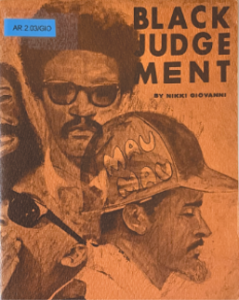
Nikki Giovanni – Black Judgement (AR.2.03/GIO). Published by Broadside Press, an independent publisher tied to the 1960s counterculture movement, Black Judgement is Giovanni’s second poetry collection. Her acclaimed “Nikki-Rosa” is included alongside other poems about Black life, pride, and power.
Experience, Suggestions and Takeaways:
I listened to a taxi driver talk about the precarity of labour rights for gig workers. After dinner, my roommate and I discussed her research in tech misinformation and empiricism. I spoke to a neighbour about getting an arm tattoo and how we remember loved ones. One night, I made friends at the club who had used some of the RACE Centre’s collections days prior. I sat in a few sessions at our first summer school, and I had a blast talking to students about English and American life while watching Fortnite clips.
I found that these seemingly disparate moments guided my current projects. What are people resonating with in this current moment? How are we meeting people where they are? How do we express complexity without devolving into reduction? Knowing how people relate to history and to their current conditions has helped me structure what I want to share with my work.
I love thinking about history as a science, and any good scientist would never do a trial once and publish. They repeat until they have a series of results from which they can analyse and pivot. We need to think about historical research as experiments! In my research guide, I’m working on an intro to “archival thinking.” Sometimes, the relationship between the heritage sector and visitors can devolve into passive, consumptive engagement with history. I want people who might feel inexperienced about American history or research to learn what it means to evaluate, question, and synthesize a source. Public history can be an effective space for skill development, which requires us to orient our work towards active engagement and critical inquiry. How do you communicate those skills? By knowing your audience! So, talk to people! Learn from people! It’s called public history for a reason!
Next Steps:
I will continue this work remotely for the next year, but my time at our HQ in Manchester Central Library ends this week. Thanks for having me here!