
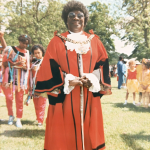
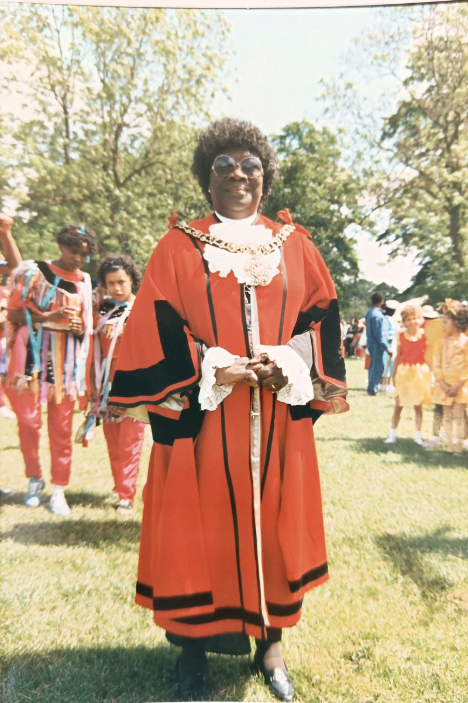
Yomi Mambu in mayoral robes at Manchester Caribbean Carnival (1989). Ahmed Iqbal Ullah RACE Centre. (GB3228.09/7/23)
Parise Carmichael-Murphy
Honorary Research Fellow, Ahmed Iqbal Ullah RACE Centre
The Commemorative Bust
I am always drawn to the visible, physical artefacts that mark Manchester’s Black histories in the city centre. One of these is the commemorative bust of Yomi Mambu on display at the Manchester Town Hall Extension, made by Manchester-based sculptor Sol Garson. Garson gifted a pair of busts to Yomi to memorialise her time as Lord Mayor of Manchester (1989-90). Yomi presented one bust to Manchester City Council, now part of the Town Hall Collection, and sent the second to her country of birth, Sierra Leone.
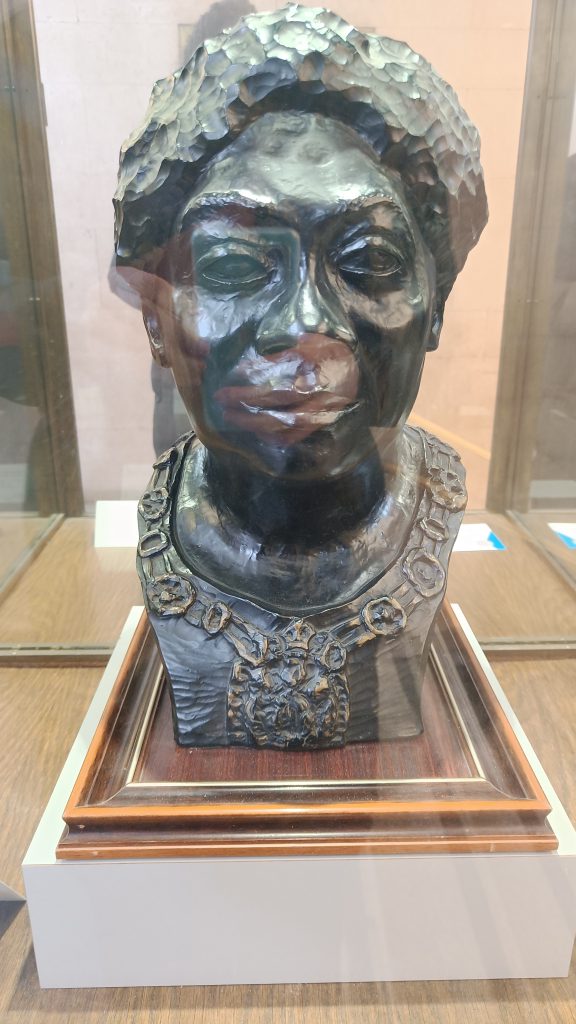
Yomi Mambu bust by Sol Garson (1991), Manchester Town Hall Extension. Town Hall Collection.
While the bust marks a significant civic achievement, less is known about her work before and after her year in office. I set out to learn more about Yomi Mambu and share what I found in this blog. The blog features collections at the Ahmed Iqbal Ullah RACE Centre, alongside material at the Working Class Movement Library and reporting from the Manchester Evening News. In addition to Yomi’s achievement of becoming the first Black Lord Mayor of Manchester, I learned about her deep commitment to gender equality, anti-racist politics, trade union organising, and international solidarity.
Yomi Mambu in the Archive
I began my research at the Ahmed Iqbal Ullah RACE Centre, a short walk from where the Yomi Mambu bust is on display at the St Peter’s Square entrance of the Town Hall Extension. The RACE Centre features collections that span race and political organising in Manchester, so I was not surprised to find that Yomi appears across several of their archives, including the Material of Fatima Begum, Marilyn Cuffy Papers, Carnival Collection, and Manchester Bangladeshi Women’s Organisation Ananna Papers. Yomi’s presence across the RACE Centre’s collections reflects the breadth of her activism, organising and community work. The Manchester Evening News archives documented much of Yomi’s public life as Lord Mayor, and campaign materials at the Working Class Movement Library helped me learn more about Yomi’s work as a Labour councillor. At the Movement Library, I was excited to find a photograph of Yomi standing with the bust, alongside Sol Garson and two others.
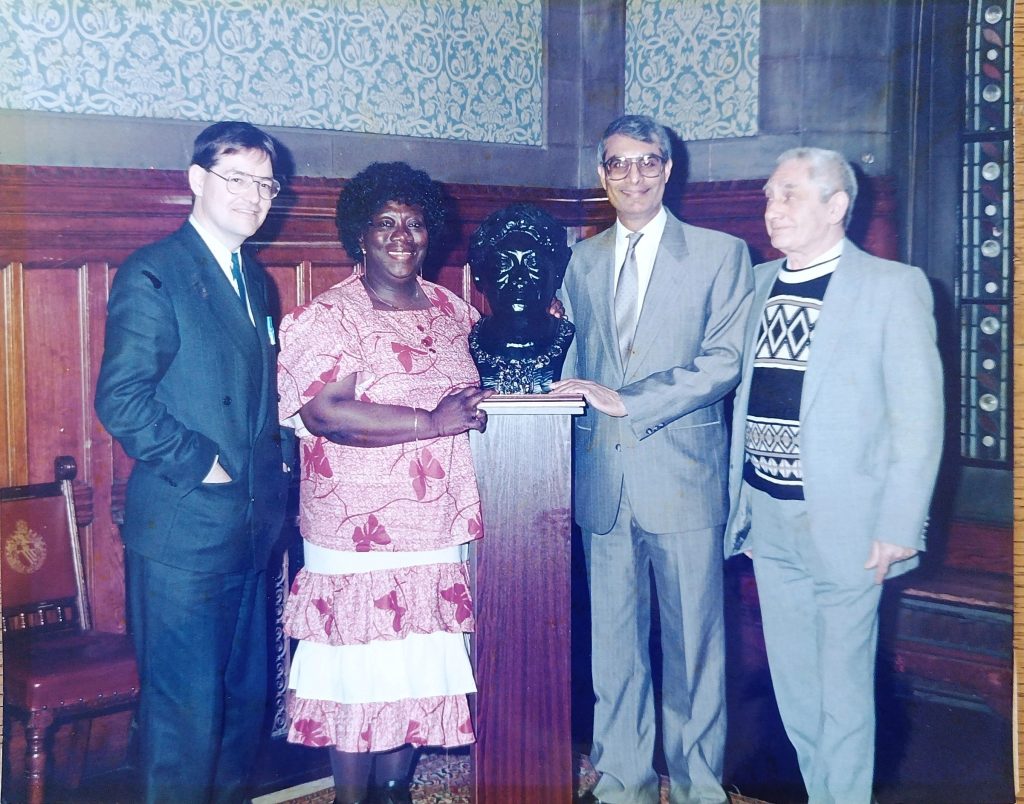
Yomi Mambu with Sol Garson, others and the completed bust (1991). Working Class Movement Library, Salford. (IMG/PP/GARSON/0001).
Finding Yomi Mambu in the archive revealed a life not defined by a single ceremonial year, but by decades of labour: nursing within the NHS, trade union organising, local political advocacy, anti-racist and anti-apartheid campaigning, and international solidarity work.
From Freetown to Manchester
Sarian Abayomi Mambu was born in 1929 in Freetown, Sierra Leone. She moved to Britain in 1958 with her husband and children and eventually settled in Longsight, Manchester. Yomi worked as a nurse in the NHS for more than thirty years: she completed training at Prestwich Hospital and then worked as a maternity nurse at St Mary’s Hospital. As a nurse, Yomi became involved in trade union organising through the National Union of Public Employees (NUPE), serving as a union representative and later representing the union within the Central Manchester Labour Party. By the late 1980s, she had become a Labour councillor for Rusholme, serving as deputy chair of both the Social Services Committee and the Race Committee.
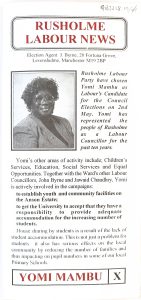
Rusholme Labour News leaflet announcing Yomi Mambu’s appointment as Labour Candidate (no date). Ahmed Iqbal Ullah RACE Centre, Manchester. (GB3228.19/6/1)
A Year as Lord Mayor
In 1989, at the age of 59, Yomi Mambu was elected Lord Mayor of Manchester, and she used the visibility of her role to draw attention to inequality in Manchester and globally. When sworn in, Yomi requested that the fur be removed from the civic robes in protest against animal cruelty when she was sworn in to office, and this act drew the attention of the national press. Though celebrated as the city’s first Black Lord Mayor, Yomi made it clear that she did not want to be solely defined by race. In an interview, Yomi emphasised that she was “not a Black councillor, but a Labour councillor who is Black”, and that her appointment was significant “for women, not just for Black women”.
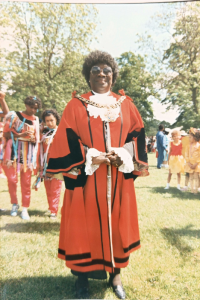
Yomi Mambu in mayoral robes at Manchester Caribbean Carnival (1989). Ahmed Iqbal Ullah RACE Centre. (GB3228.09/7/23)
Trade union organising and anti-apartheid politics were central to Yomi’s public work during her mayoralty. She addressed the Trade Union Congress (TUC) National Demonstration against Poll Tax, spoke at Trade Unions Against Apartheid events, and participated in meetings of the Southern Africa Coalition in Westminster, where she advocated for sanctions against apartheid South Africa. Yomi also officially opened Manchester’s Anti-Apartheid Week at the Town Hall and officially renamed the ‘Mandela Room’ at the GMB Union offices in Whalley Range, embedding anti-apartheid politics within local trade union spaces.
Alongside this political work, Yomi carried out ceremonial duties as Lord Mayor, such as officially opening Manchester’s Caribbean Carnival, hosting international delegations, and representing Manchester internationally. She was an avid Manchester United supporter, regularly attending home matches and even hosting a civic reception for the team following the 1990 FA Cup Final. Whilst in office, Manchester made a bid for the 1996 Olympics, and Yomi travelled to Rabat with Guyanese cricketer Clive Lloyd to meet with the Association of National Olympic Committees of Africa. During this period, she met with Sam Ramsamy, executive chairman of the South African non-racial Olympic Committee, who praised Manchester City Council’s commitment to the anti-apartheid movement. Together, these engagements positioned Manchester within the wider international conversation about sport, sanctions and racial justice.
As the city’s first Black Lord Mayor, Yomi experienced great scrutiny. She spoke out about experiencing racism in her neighbourhood and in encounters with the police. At her first press conference as Lord Mayor, a journalist reportedly asked Yomi: “What part of Africa are you from, do you know?” To which she wittily replied: “The only jungle I have ever seen was in Manchester, and the first lion I ever came across was in Belle Vue.” Even before stepping into the role, Yomi was highly scrutinised as a potential candidate. Press coverage reported on her past council housing arrears and highlighted beliefs that she was too inexperienced to take up the office. During the inaugural meeting of the newly formed Women from Africa group at the Town Hall, a Conservative MP reportedly told Yomi to “go back to Africa”.
Equality Work in Manchester
After her year in office, Yomi remained active as a Labour councillor for the Rusholme Ward throughout the 1990s. She chaired the City Council’s Equal Opportunities Committee and Women’s Sub-Committee, leading anti-discrimination, multicultural programming, and providing funding for women-led initiatives across the city. Yomi’s work and campaigning spanned a range of issues, including housing, transport, education, youth provision, resident forums, and community infrastructure on the Anson Housing Estate in Longsight. Through her role on the council’s Social Services Committee, Yomi advocated for better resources for the Bangladeshi Women’s Project in Longsight.
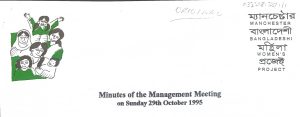
Minutes of the Management Meeting of Manchester Bangladeshi Women’s Project with Yomi Mambu in attendance (1995). Ahmed Iqbal Ullah RACE Centre. (GB3228.58/1/1)
Gender equality remained a key focus for Yomi throughout the 1990s. Newspaper reports document Yomi’s involvement and promotion of grant schemes for women, the relaunch of the Manchester Women’s Electronic Village that supported women with access to technology training, and the publication of literary collections by Afro-Caribbean and Asian women writers in the North West. These activities reflected Yomi’s sustained commitment to ensuring that equality work extended beyond policy into cultural and community life in Manchester.
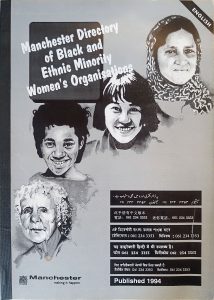
Manchester Directory of Black and Ethnic Minority Women’s Organisations (1994), foreword by Yomi Mambu. Ahmed Iqbal Ullah RACE Centre. (GB3228.13/11/2)
While Yomi Mambu remained focused on neighbourhood and equality politics in Manchester, her activism connected local civic work to wider international struggles. Alongside her anti-apartheid campaigning, Yomi remained connected to wider African political and community networks. In 1994, Yomi and community activist Elouise Edwards received honorary chieftaincies in Nigeria and were awarded the ceremonial title ‘Mama‘ in recognition of their public service and community leadership. Later in the decade, she also helped raise awareness of the civil war in Sierra Leone through discussions with parliamentarians and the Foreign Commonwealth Office.
Remembering Yomi Mambu
The bust of Yomi Mambu in the Manchester Town Hall Extension commemorates her time in office as Lord Mayor of Manchester. Local archives and newspapers help us learn more about her politics, campaigning and work for equality. It is not surprising to find that Yomi is present across several collections at the RACE Centre, materials at the Working Class Movement Library, and across the pages of the Manchester Evening News.
Today, you can visit the West Tower of Manchester Cathedral, where you’ll see Yomi Mambu’s name painted on the walls along with the names of her predecessors and successors. At the same time, the ‘Mambu Room’ at St Thomas Centre in Ardwick honours her political work. Yomi’s act of distribution, gifting one of the busts to Manchester City Council and sending the other to Sierra Leone, is deeply symbolic. The sculpture in the Town Hall commemorates her time as Lord Mayor. Still, its existence across two locations also reminds us that Manchester’s civic history is one connected to wider histories of migration, international solidarity and transnational belonging.
Recovering Yomi Mambu’s political life through Manchester archives and newspapers reveals how deeply interconnected Black, working class, migrant and women’s histories are in Manchester, as well as how much of that history is preserved by community archives and local collections.
Sources
Mambu, Y. (1992). City Council elections, Thursday May 7th 1992: Rusholme Ward (36028956). Working Class Movement Library, Salford, UK.
Manchester Directory of Black and Ethnic Minority Women’s Organisations. (1994). Marilyn Cuffy papers: Manchester Black Resource Centre and other community and support groups (GB3228.13/11/2). Ahmed Iqbal Ullah RACE Centre, University of Manchester, Manchester, UK.
Manchester Evening News. (1987, November 20). Storm over ‘race jibe’. Page 16.
Manchester Evening News. (1989, April 18). A straight-talker, that’s our Yomi. Page 8.
Manchester Evening News. (1989, June 06). Playing it by the jungle book. Page 6.
Manchester Evening News. (1991, April 24). Carving Yomi’s place in history. Page 6.
Minutes of the Management Meeting on Sunday 29th October 1995. (1995). Annana papers: Manchester Bangladeshi Women’s Organisation (GB3228.58/1/1). Ahmed Iqbal Ullah RACE Centre, University of Manchester, Manchester, UK.
Photograph – Sol Garson sculpture. (1991). (IMG/PP/GARSON/0001). Working Class Movement Library, Salford, UK.
Photograph of Yomi Mambu. (1989). Carnival Collection (GB3228.09/7/23). Ahmed Iqbal Ullah RACE Centre, University of Manchester, Manchester, UK.
Rusholme Labour News. (no date). Material of Faitma Begum (GB3228/19/6/1). Ahmed Iqbal Ullah RACE Centre, University of Manchester, Manchester, UK.